Before E7: Optimize Teams Phone and Unlock Copilot Value in E5
Most organizations are overpaying for Microsoft Teams Phone. Learn how to optimize licensing in E5, eliminate duplicate telephony, and turn savings into Copilot investment.

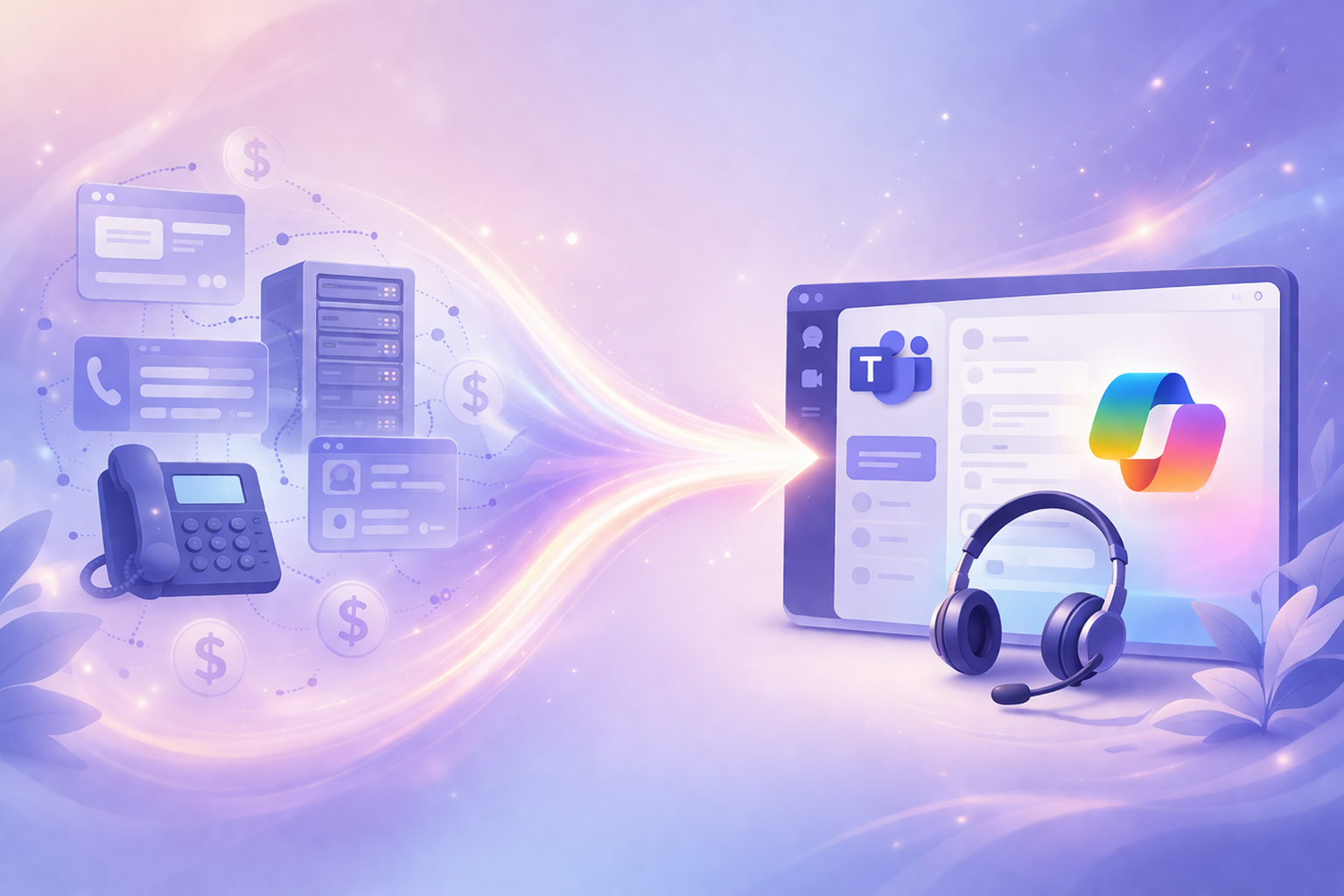
E5 includes Teams Phone System. So if you're still running a separate phone system alongside it, whether that's an on-premises PBX like Cisco or Avaya, or a cloud UCaaS platform like Zoom Phone or RingCentral, you're paying for phone infrastructure twice. Not because you need to. Because nobody has made the call to switch it off.
Making the switch solves one problem. It tends to create another.
The vast majority of organizations activate Teams Phone and then provision everyone identically, with full calling plans and dedicated numbers across the board. In a world where most employees make only a handful of external calls each week, that's a different kind of overpaying. Getting the calling model right needs to be part of the deployment and revisited regularly, because roles change.
Both problems are fixable. And fixing them together creates a funding source for something far more valuable. For organizations investing in Microsoft 365 Copilot, this isn’t just a cost problem, it’s a funding opportunity hiding in plain sight.
With the introduction of Microsoft 365 E7, Microsoft is clearly doubling down on AI. But the bigger opportunity for most organizations is still in how effectively they’re using what they already have.
Most organizations haven’t come close to exhausting the value of E5.
You're Already Paying for Teams Phone — You're Just Not Using It
Teams Phone System is one of the most frequently overlooked entitlements in Microsoft 365 E5. It's included, it's enterprise-grade, and in most E5 organizations still running a separate telephony platform, it's sitting dormant while the old system quietly runs up another month of license fees, maintenance costs, and infrastructure overhead. The total cost of that parallel platform — whether on-premises or a UCaaS subscription like Zoom Phone or RingCentral — is rarely captured in a single line item. Per-seat fees, contract commitments, integration costs, admin overhead. For organizations that have done the honest total cost of ownership (TCO) exercise, the conclusion is consistent: the true cost is higher than it looks, and the case for switching it off is clear.
Forrester's Total Economic Impact™ study of Microsoft 365 E5, commissioned by Microsoft, puts average per-user savings at $86.25/month when organizations consolidate legacy solutions onto E5 — telephony alone accounts for $12 of that figure. For organizations still running a separate phone system alongside E5, that's a directly recoverable cost hiding in plain sight.
Moving to Teams Phone Is Only Half the Job
Activating Teams Phone solves the double-payment problem. But it introduces a second decision that most organizations get wrong: they license and provision everyone the same way.
Every user gets a full domestic Calling Plan. Every user gets a dedicated number. Every user pays the same — regardless of whether they make ten external calls a day or ten a month.
The rise of Teams and videoconferencing has fundamentally changed who actually makes and receives PSTN calls, and how often. In most organizations, genuine heavy callers represent a fraction of total headcount. The rest might handle a handful of external calls a week, if that. Licensing everyone identically means paying a significant premium for capabilities the majority of your users simply aren't using.
Microsoft has built the flexibility to fix this. There are three distinct calling models in Teams Phone, each designed for a different usage profile:
Shared Calling pools a single PSTN number across a group of users. No individual direct dial, but the group is reachable. The right fit for frontline workers, shared desks, or any cohort where personal reachability isn't a business requirement. Licensing cost per user drops significantly with no degraded Teams experience. If you want the full picture on how Shared Calling works in practice, Microsoft Teams Shared Calling — Everything You Need To Know (2025 Edition) is worth a read.
Pay-as-you-Go gives each user their own dedicated number — so they can be reached directly — but charges for outbound calls as consumed rather than bundling a monthly allowance. The best fit for knowledge workers who receive calls regularly but rarely dial out. For these users, a flat-rate plan is paying for minutes they'll never use.
Calling Plans are the right choice for genuine high-volume users — sales, support, account managers. Anyone whose job involves regular outbound calling benefits from a bundled plan with predictable costs.
 ✓
All three options bring calls into Teams — where Microsoft 365 Copilot can see them
✓
All three options bring calls into Teams — where Microsoft 365 Copilot can see them
What This Looks Like at Scale
To make this concrete, take a 5,000-seat organization where everyone has been provisioned identically with a US domestic calling plan — Teams Phone with Calling Plan at $17 per user per month. That's $85,000 a month, or just over $1 million a year.
Next you pull call activity and segment users by actual behaviour. Around 500 users are genuine heavy callers — sales, support, external-facing roles — who fully justify that $17 plan. Another 1,000 receive calls regularly enough to need their own direct number, but rarely initiate outbound calls. For these users, Teams Phone with Pay-as-you-Go at $13/user/month is the right fit — they get their dedicated number, and pay for outbound minutes as consumed rather than subsidizing a bundled allowance they'll never use. The remaining 3,500 users barely touch the PSTN and are natural candidates for Shared Calling, where Teams Phone Standard at $10/user/month gives them full Teams functionality and PSTN reachability via a shared number.
Right-size the estate across those three groups — including a conservative estimate for outbound minutes on the Pay-as-you-Go and Shared Calling tiers at $0.02/min — and the monthly bill drops from $85,000 to approximately $57,800. That's a saving of around $27,200 per month, or $326,400 per year. Without removing a single user's ability to make or receive calls.
= $8,500/month
= ~$13,600/month
= ~$35,700/month
Outbound minute estimates assume ~30 mins/month for Pay-as-you-Go users and ~10 mins/month for Shared Calling users, based on Microsoft's published US calling rates of $0.01–$0.02/min for domestic calls.
The First Layer of an AI-Enabled Phone System
Right-sizing calling plans isn't just a cost exercise. It's an architectural decision — and one that determines whether your phone calls become useful data or stay invisible.
For most organizations, voice is one of the last major categories of work that isn’t consistently visible to Microsoft 365 Copilot. That changes the moment calls move into Teams. Every calling model — Shared Calling, Pay-as-you-Go, and full Calling Plans — brings PSTN activity into the Teams ecosystem. Moving someone to a cheaper plan doesn't move them outside it. Their calls still happen in Teams, which means those interactions can become visible to Copilot.
That's the part most organizations miss when they think about right-sizing. A user on a $10 Shared Calling plan with a Copilot licence gets the same Intelligent Call Recaps, action items, and voice isolation as a user on a $17 Calling Plan. The tier affects the cost. The Copilot licence determines the AI experience.
Which is exactly why the right-sizing conversation and the Copilot conversation belong together — and why the math matters. At $30/user/month, the $326,400 in annual savings from right-sizing alone would fund Copilot for over 900 users, before a single legacy platform has been decommissioned. Add the savings from retiring that third-party telephony platform, and the number grows further. Not new budget. Redeployed spend.
The Bottom Line
The organizations that will get the most out of Microsoft 365 Copilot over the next three years aren't necessarily the ones with the biggest AI budgets. They're the ones that did the unglamorous work first — auditing what they already own, decommissioning what they've outgrown, and licensing deliberately rather than reflexively.
If you're on E5, Teams Phone System is already paid for. The third-party telephony costs are hiding in plain sight. And the calling plan mix almost certainly doesn't reflect how your organization actually communicates in 2025. E7 will raise the bar again. But most organizations haven't finished unlocking what E5 already includes.
The question is just whether anyone's looked.